Orcool treats performance creative as a chain of decisions, not a batch of files. Evidence enters from the market. An agent calls the signal layer through MCP. A human locks one testable hypothesis. Production creates traceable descendants. The advertiser's agreed KPI gate—not Orcool—decides whether anything won.
Most creative-system demos skip the middle. They show an input box, then a polished video, then a graph going up. The missing part is where the business risk actually lives: who decided which evidence mattered, what the production team was allowed to change and what counted as proof after the work entered spend.
We want that middle to be inspectable. The walkthrough below uses public-safe artifacts from Orcool's working system and already published production. Some examples come from different categories because client performance data and live briefs are not interchangeable marketing assets. This is a view of the mechanism, not a fabricated single-client case study.
01 · Source evidenceStart with a market mechanic, not a mood board.
Signal sourcing starts with observable material: competitor ads still receiving distribution, recurring structures across a category, the language users repeat in reviews and support, and local behavior that changes what a scene or claim means.
The unit of value is not “this ad looks good.” It is a mechanic that can survive a production brief: a problem state, a proof structure, a setting, a hook, an objection or a sequence that appears often enough—or lasts long enough—to deserve a controlled test.
A concrete roaming problem appears before the product, turning “travel freedom” into a specific cost tension.
Open inside the failure moment. The product earns attention as the resolution rather than the premise.
Airport friction beats a generic destination montage when the hypothesis is about avoiding roaming cost.
02 · Call the signal layerThe agent should retrieve evidence, not improvise it.
The MCP layer exists so the same signal can be called from Claude, ChatGPT or Cursor while the team is already writing, planning or reviewing. The agent does not need another dashboard tab. It needs an authenticated way to ask Orcool for category patterns, competitor examples or a market map and bring the answer into the current task.
This changes the role of the prompt. “Give me ten hooks” invites generic generation. “Use Orcool to find repeated problem states in the category, show the supporting examples and turn the strongest one into three bounded hook hypotheses” gives the agent evidence, a selection rule and a production-shaped output.
03 · Lock the hypothesisMake the brief narrower as the evidence gets richer.
Good intelligence should reduce the degrees of freedom in production. The brief locks the audience, problem state, mechanism, required proof, claims boundary, format and the one variable each descendant is allowed to test.
That is the difference between a lineage and a pile of variants. If every script changes the hook, setting, proof and CTA at once, live media can tell you which file won but not what the system learned.
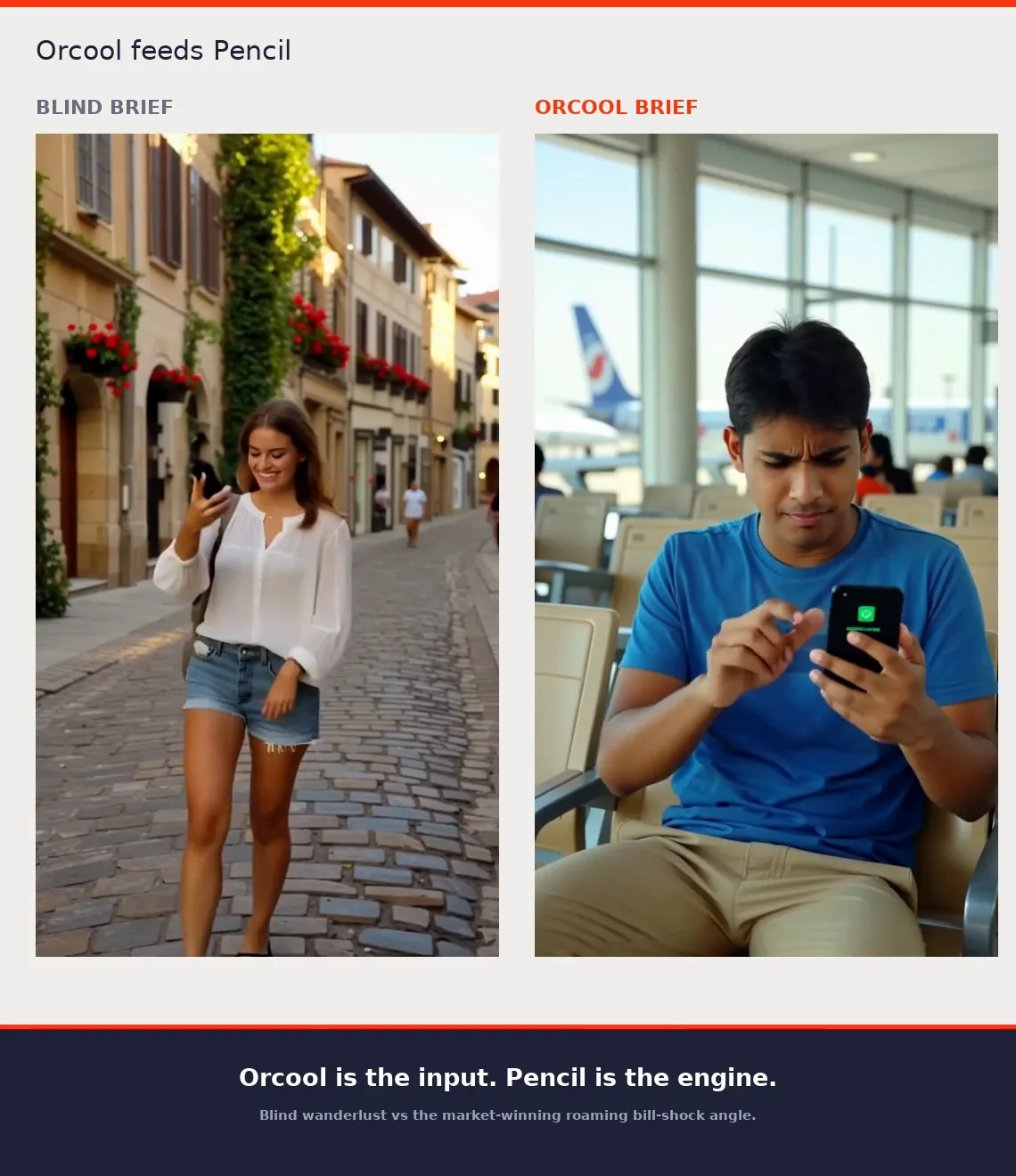
Evidence to preserve: concrete failure moment, visible phone behavior, immediate financial tension.
The baseline concept holds the mechanism, scene and proof sequence constant.
Same scene and resolution. Tests whether specificity at second zero changes the gate.
Same hook and scene. Tests whether on-screen cost comparison earns more trust.
04 · Produce traceable variantsProduction is a controlled experiment with craft.
Once the hypothesis is locked, production can move quickly without becoming arbitrary. Casting, generated footage, product captures, voice, captions and edit rhythm still require taste. The constraint is that craft choices cannot erase the variable the test is supposed to isolate.
The production output itself stays private unless the client explicitly approves publication. What can be shown safely is the control layer around it: every delivered asset must point back to its source mechanic, record what changed and carry the approvals required before it enters media.
The asset records which evidence and test variable justified the render.
Copy, likeness, music, territory and usage scope are reviewed before delivery.
Permission to run an asset does not automatically include permission to publish it as an Orcool case study.
05 · Let spend decideA winner is an external event.
Orcool can form the hypothesis, fund the agreed production scope and keep the lineage traceable. It cannot declare that its own work won. The winner gate belongs to the advertiser operating the media account.
Before production begins, a real test needs a numeric KPI threshold, attribution rules, an observation window, minimum delivery conditions and a named person who can confirm the result. Without those definitions, “winner” collapses back into preference.
After the gateDo not restart after a winner.
A winning asset contains information about the mechanism, message, scene and audience. The next production cycle should preserve the elements the evidence supports and change only what the next hypothesis requires.
That is where speed becomes compounding rather than volume. Orcool's working production target is to create controlled descendants within 48–72 hours after a usable winner signal and required approvals. It is a process target, not a promised business result.
The larger metric remains Time-to-Winner: calendar days to an ad that clears the agreed gate and holds long enough to matter. Faster rendering can help that number. Better signal selection, a narrower brief and a clean evidence loop usually matter more.
Try the first handoff
Call Orcool from the agent you already use.
Connect the MCP, map your category and inspect the evidence before deciding whether a funded production pilot makes sense.